


EOSC Node Data Terra is moving into production, making FAIR, AI-ready, multi-domain data, services and computing for Earth system, biodiversity and environmental sciences available through the EOSC Federation and opening new opportunities for cross-border and cross-disciplinary research.
Paris, 9 October 2026—EOSC Node Data Terra has entered production as part of the European Open Science Cloud (EOSC) Federation, marking the transition from developing and prototyping the Node to delivering operational services and resources for researchers. This moment marks the culmination of almost a decade of European, national and organisational investment in the development of EOSC.
The Node brings together more than 30 French research organisations and universities, under the legal responsibility of CNRS and in partnership with the German NFDI4Earth consortium, coordinated by TU Dresden. Data Terra brings together the resources of its five thematic hubs: atmosphere (AERIS), ocean (ODATIS), land surfaces (THEIA), solid Earth (FormaTerre) and biodiversity (PNDB). The EOSC Node provides a federated resource catalogue, single sign-on connected to EOSC AAI, and virtual research environments (Galaxy, Jupyter) Through the Federation, these resources can be discovered and used alongside complementary capabilities provided by other EOSC Nodes across Europe.
The EOSC Federation as a whole will mark the entrance into its operational phase at the EOSC Symposium 2026 in Florence on 14–16 October. The EOSC EU Node and the Federation’s 27 national, thematic and e-infrastructure Nodes—supported by 218 European research organisations—are creating a distributed European research environment in which data, services and computing resources can be used across institutional, disciplinary and national boundaries. This month’s transition into operations ushers in a growth phase for the Federation that will see an expansion of Nodes, data and services year over year.
The Federation is designed to make high-quality research data and services easier to find, access and reuse while supporting FAIR and open science, provenance, security and trusted access. Across EOSC, ongoing scientific use cases already span areas including climate and marine science, advanced imaging and AI-supported discovery.
The EOSC Node Data Terra implements several multi-node scientific UCs:
EOSC embodies an important European approach to research-data governance designed to counter global pressures on European data sovereignty. This is achieved through distributed ownership, institutional autonomy, interoperability and cooperation under shared rules.
Within this proven framework, EOSC Node Data Terra will continue to improve its services for researchers, expand the resources available through the Federation and develop new connections with scientific communities and other Nodes. .
“Entering production means that EOSC Node Data Terra is moving from preparation to delivery. Researchers can now begin to benefit from FAIR, AI-ready Earth system, biodiversity and environmental data and services within a broader European ecosystem, while the resources developed by our community can contribute to scientific research far beyond our institution and individual domains.”
— Alessandro Rizzo, Coordinator, EOSC Node Data Terra (Data Terra Research Infrastructure)
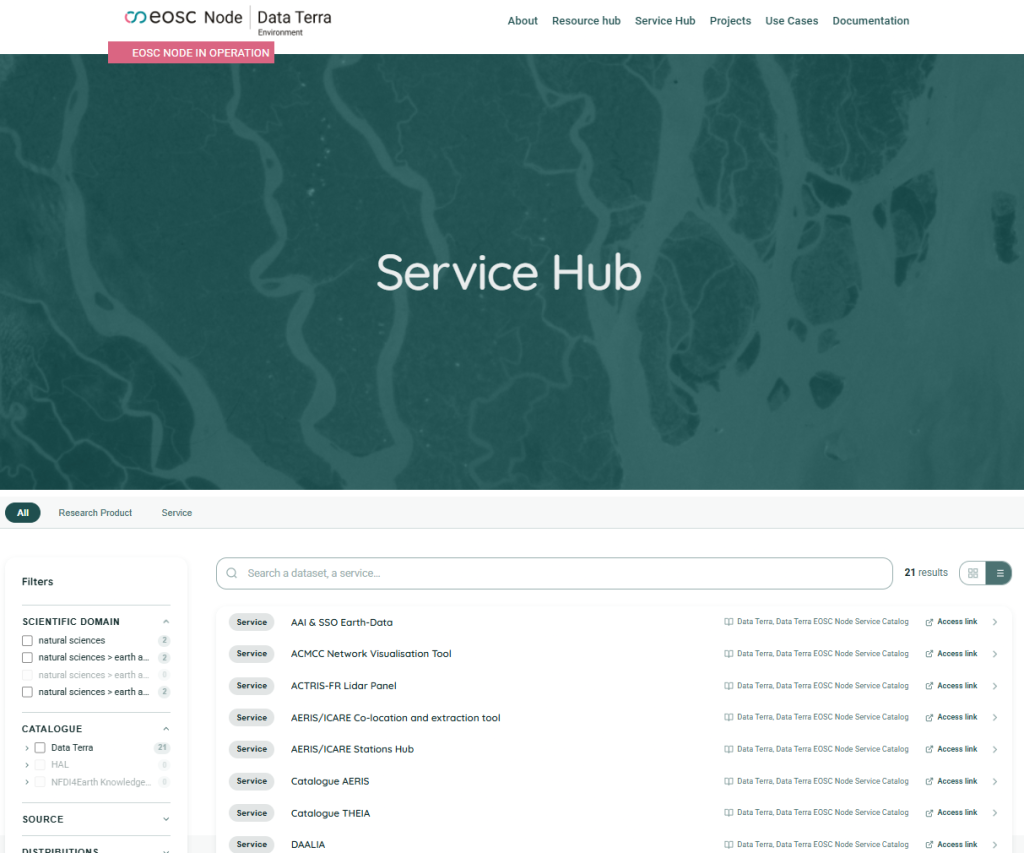
EOSC Node Data Terra is the French national thematic e-infrastructure for Earth system, biodiversity and environmental sciences, operated under the legal responsibility of CNRS and developed with NFDI4Earth. It federates five data and service hubs and offers single sign-on, a resource catalogue, Galaxy and Jupyter environments and cloud resources.
The European Open Science Cloud is a federated European environment for research data and services. It connects distributed national, thematic and infrastructure resources through common technical and governance arrangements, enabling researchers to access and reuse data and services across institutional and national boundaries.
Marina Ripon, Communication Officer, EOSC Node Data Terra — contact@earth-data.eu
