


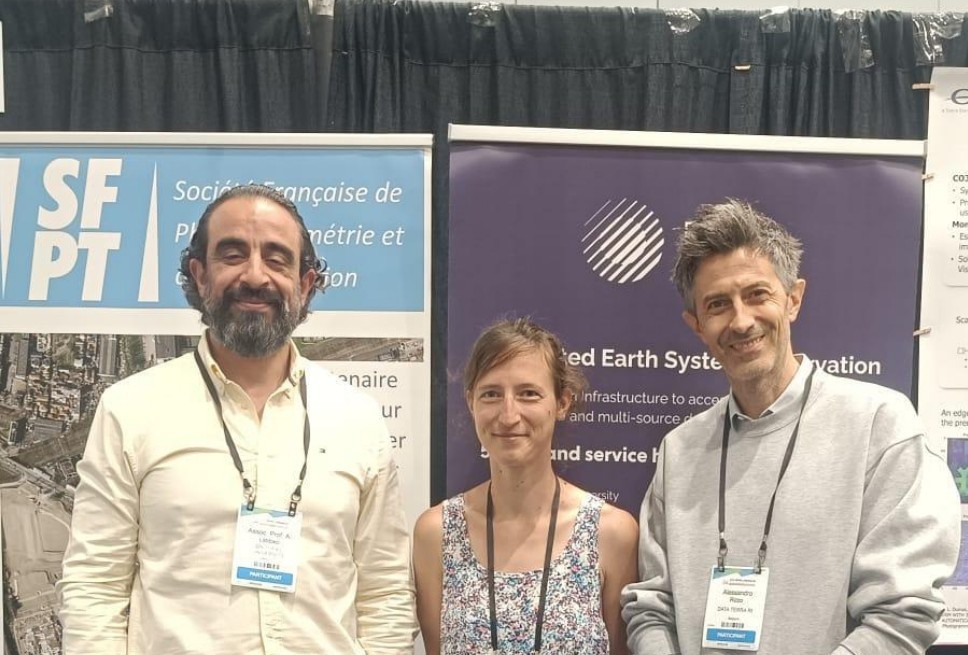
Entrusting the presidency of the Commission to Alessandro Rizzo, alongside Professor Adnane Labbaci as Vice-President, together with Aline Deprez and Alexandre Hippert-Ferrer as Scientific Secretaries, fully reflects the dynamic nature of the joint France–Morocco bid. This governance structure will be a key lever for organising multidisciplinary working groups and ensuring balance and complementarity between the two countries — a cornerstone of this Franco-Moroccan initiative.
France has been elected to chair one of the Technical Commissions of the International Society for Photogrammetry and Remote Sensing (ISPRS), thereby strengthening its leading position in the fields of remote sensing, photogrammetry and geospatial information science.
This election recognises the long-standing commitment of the French community to the development of innovative methods, data infrastructures and services for observing the Earth system and the environment. It also reflects the confidence of the international community in France’s ability to promote an ambitious, open and inclusive scientific agenda.
Dr Alessandro Rizzo is presenting, on behalf of the French Data Terra Research Infrastructure, France’s bid to host the presidency of ISPRS Technical Commission V — TC V: Education and Outreach — for the 2026–2030 term. Data Terra brings together 34 research organisations and universities, including CNRS, CNES, IRD, IGN, Ifremer and INRAE, among others, to support integrated observation of the Earth system. Through this bid, France is mobilising a large and active community in remote sensing and geomatics, established training networks, and recognised experience in coordinating major international projects, building on existing research platforms and infrastructures.
Data Terra is a leading French and European research infrastructure dedicated to access to space-based and in situ data from Earth system and environmental sciences. Built on a broad geospatial ecosystem, it strongly supports the French remote sensing and photogrammetry community and contributes to the development of long-term international partnerships.
Frédéric Huynh, Director of the Data Terra Research Infrastructure, explains: “Through Data Terra, France is making available to ISPRS a research infrastructure based on five thematic data and service centres covering the atmosphere through AERIS, continental surfaces through THEIA, the ocean through ODATIS, the solid Earth through FormaTerre, and biodiversity through PNDB. It also includes cross-cutting services for access to very high-resolution satellite data, scientific mediation capacities, and collective expertise on data FAIRification and artificial intelligence. This is further strengthened by its European dimension, embodied by the Data Terra–Environment node of the European EOSC programme. Within the framework of ISPRS, our vision is to interconnect national and European facilities and platforms with other national and international initiatives around Earth observation, the sharing of qualified geospatial data, and the implementation of integrated approaches to environments and societies.”
Securing the presidency of ISPRS Technical Commission V — Education and Outreach — is a major objective for France. It will help support and harmonise education and training at the global level, while contributing to the Sustainable Development Goals by mobilising the potential of geospatial data, technologies and expertise for stakeholders and decision-makers. The development of open educational resources, online and hybrid training, including MOOCs, and international outreach activities — with particular attention to students and early-career researchers — lies at the heart of the identity and mission of this bid.
Entrusting the presidency of the Commission to Alessandro Rizzo, alongside Professor Adnane Labbaci as Vice-President, together with Aline Deprez and Alexandre Hippert-Ferrer as Scientific Secretaries, fully reflects the dynamic nature of the joint France–Morocco bid. This governance structure will be a key lever for organising multidisciplinary working groups and ensuring balance and complementarity between the two countries — a cornerstone of this Franco-Moroccan initiative.
Dr Alessandro Rizzo has been a research engineer at IRD for more than twenty years. He coordinates the deployment of the European Data Terra–Environment node within EOSC and contributes to the development of the Data Terra Research Infrastructure, dedicated to Earth system data and environmental sciences.
“Through Data Terra, France enables ISPRS to build on a European EOSC node that provides tools and methods for FAIR data and services. Designed for research, but also for education, training and the large-scale reuse of Earth observation data, the services operated by Data Terra provide concrete building blocks for education, continuing professional development and learning environments dedicated to Earth observation.”
As Project Manager of the Data Terra Research Infrastructure and European Affairs Coordinator, with extensive experience in European projects such as EOSC and FAIR-EASE, Alessandro works on the “EOSC Node | Data Terra” initiative. His work focuses in particular on Data Terra’s capacity to integrate into European infrastructures and to make data FAIR and interoperable. In this respect, he embodies the vision of a sustainable, open infrastructure connected to Europe.
Professor Adnane Labbaci, Professor of Geographic Information Systems, remote sensing and digital twins at Ibn Tofail University in Morocco, and a former GIS analyst for the Department of Forestry, coordinates several Erasmus+ CBHE projects dedicated to Spatial Data Infrastructures, land management and digital twins. He has extensive international experience in deploying platforms and geoportals for education and research.
This chairmanship builds on France’s strong presence at ISPRS events and reinforces its structuring role in major international initiatives related to Earth observation, geomatics and open science. It will provide a unique opportunity to strengthen collaborations with learned societies, space agencies, research infrastructures and industrial stakeholders at both European and global levels.
French stakeholders — learned societies, research infrastructures such as Data Terra, laboratories, agencies and industrial partners — will mobilise collectively to make this mandate a lever for scientific outreach, international cooperation, and the valorisation of data and services for the benefit of research, public policies and society.
Under this chairmanship, France will promote a vision structured around three priorities.
First, strengthening scientific excellence by supporting cutting-edge research in imaging, 3D modelling, big data analysis and artificial intelligence applied to remote sensing.
Second, structuring and sharing data and service infrastructures, notably through the Data Terra e-infrastructure, which serves as the national backbone for Earth system data and their applications.
Third, accelerating dissemination, training and knowledge uptake by developing educational initiatives, training activities and outreach actions for early-career researchers, teachers, engineers and decision-makers, with the aim of making remote sensing tools accessible to the widest possible audience.
Several key activities will be proposed during the 2026–2030 period:
Organisation of summer schools, workshops, webinars and tutorials during ISPRS events and at regional level.
Development and dissemination of educational materials and best-practice guidelines for universities and training centres.
Support, wherever possible, for online platforms offering courses, videos and open-access resources in several languages.
Strengthening of links between academia and industry, in order to align education and training with market and societal needs.
Encouragement of the participation of students and young professionals through competitions, mentoring and travel grants, subject to applicable conditions.
In addition, several topics may be addressed by the working groups of Commission V, including artificial intelligence and machine learning for data analysis and fusion; FAIR principles and open science practices; Virtual Research Environments (VREs); and digital twins designed to improve the production of reliable geospatial information to address major societal challenges.
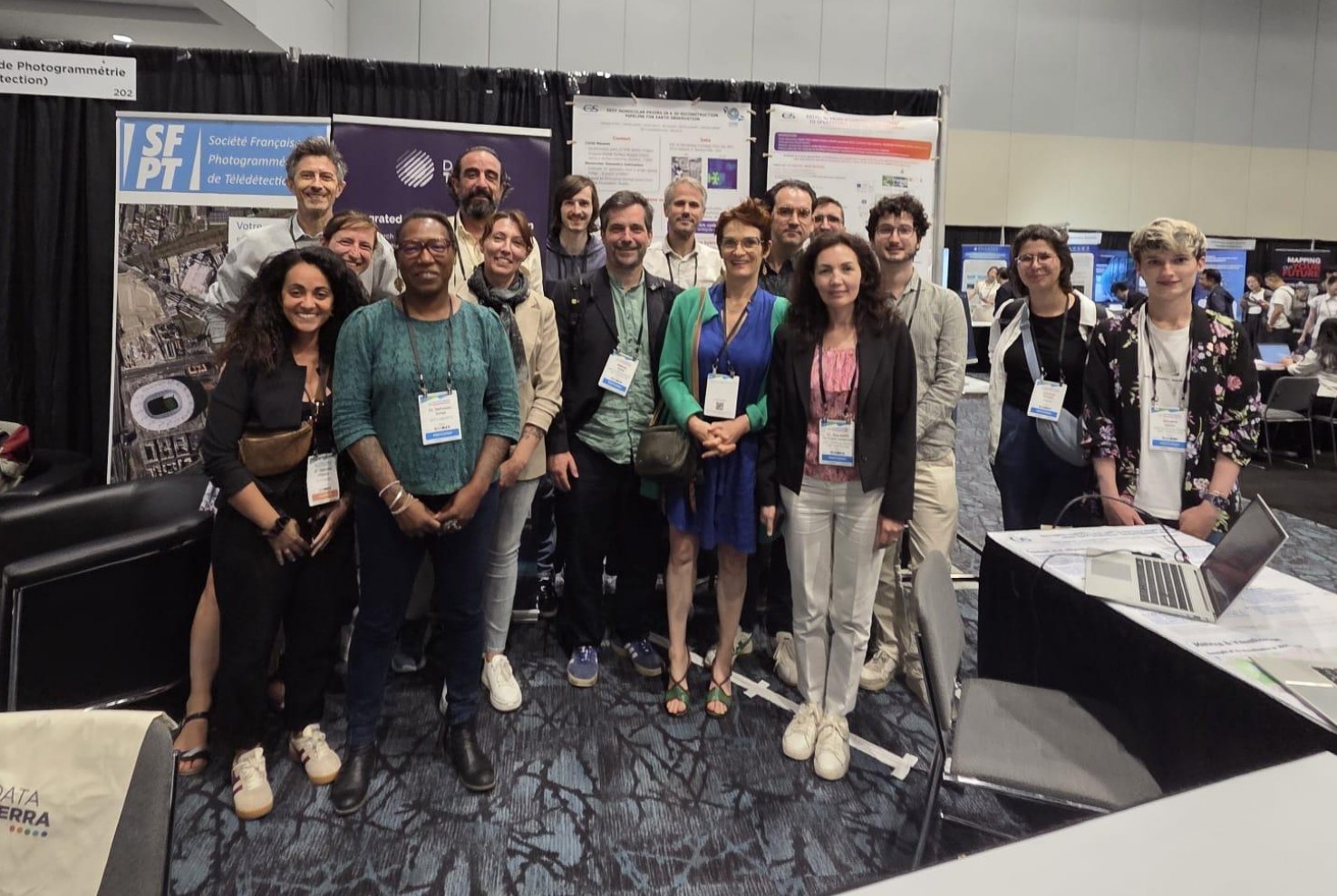
The SFPT welcomes the French bid—which will also feature an exhibition booth 202—as an opportunity to ensure high visibility for French scientific communities at the congress. Data Terra—the French e-infrastructure for Earth system data and services, which brings together five thematic hubs and several cross-cutting initiatives—will also be represented at the booth. The congress theme, « From Imagery to Understanding, » emphasizes the transition from raw data to actionable knowledge. Data Terra contributes to this effort by serving as the backbone for French Earth system data, supporting the community and building upon France’s strong presence at ISPRS 2024.
For Data Terra—the Research Infrastructure spearheading the SFPT’s bid for Technical Commission V—the primary objective is to maximize scientific visibility during the ISPRS Congress (Toronto, July 4–11, 2026). Alessandro Rizzo embodies this overarching vision: he represents both Data Terra and its European and international reach, perfectly reflecting the spirit of the French bid for Technical Commission V and the « From Imagery to Understanding » theme.
